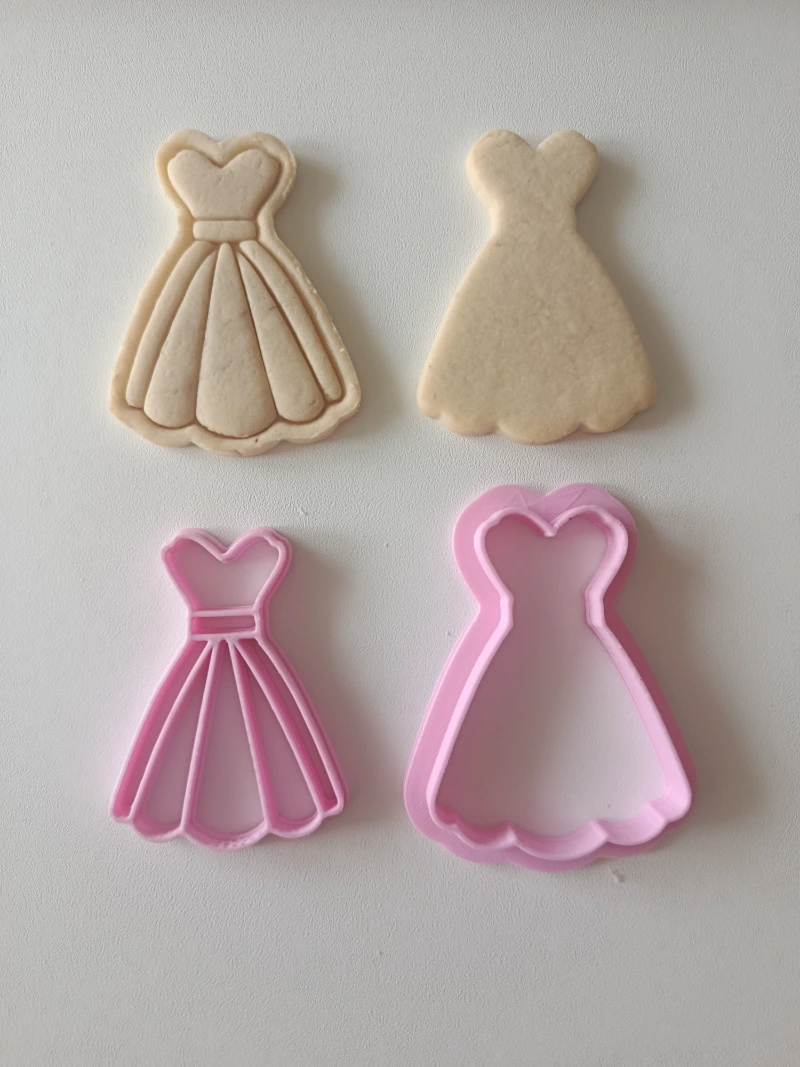
3D printed cookie cutters are becoming increasingly popular among bakeries, baking brands, gift shops, and private-label businesses. Unlike traditional stainless steel or injection-molded plastic cutters, 3D printed cookie cutters make it easier to produce customized shapes, detailed designs, and small production runs without expensive tooling.
However, one important question remains: Are 3D printed cookie cutters food safe?
The answer depends on several factors, including the raw material, manufacturing process, final product characteristics, intended conditions of use, and cleaning practices.
PLA (polylactic acid) is a common material used in filament-based 3D printing. However, not every PLA filament has the same formulation, and using PLA alone does not automatically establish that a finished product is suitable for food contact.
For businesses sourcing custom cookie cutters, it is important to look beyond the material name and understand how the products are manufactured and what supporting documentation is available.
At Canzo Kitchenware, we manufacture custom 3D printed cookie cutters using official Bambu Lab PLA filament. All our 3D printed products are produced on our own printers, and we use standard printing speeds rather than Sport or Ludicrous modes to help maintain consistent printing quality.
We can also provide EU food-contact test reports and a manufacturer’s Declaration of Compliance (DoC) for customer review, subject to the applicable product specifications and documentation scope.
In this guide, we explain the key food-safety considerations for 3D printed cookie cutters and what buyers should check before placing an order.
1. What Makes a 3D Printed Cookie Cutter Food Safe?
Food safety is not determined by one factor alone. When evaluating a 3D printed cookie cutter, buyers should consider the following aspects.
Material Composition
The filament is the starting point of the manufacturing process. Its base polymer, pigments, additives, and other ingredients can affect its suitability for food contact.
PLA is widely used for 3D printing because it is easy to process and allows manufacturers to produce detailed, customized designs. However, different PLA products may contain different formulations.
For this reason, buyers should ask manufacturers to identify the specific filament used rather than relying only on a general statement that a product is made from PLA.
Canzo Kitchenware‘s approach: We use official Bambu Lab PLA filament for our 3D printed cookie cutters. Using a consistent, identifiable material helps us maintain better control over material selection and production.
Nevertheless, the suitability of the finished cutter must be evaluated using the relevant evidence for the actual product and its intended use.
The Finished Product and Printing Process
Unlike injection-molded plastic, FDM 3D printing builds a product layer by layer. The resulting surface can contain visible layer lines, small grooves, and areas that are more difficult to clean.
The final quality depends on several factors, including the printing parameters, design geometry, material condition, and consistency of the manufacturing process.
Poorly formed edges, gaps, or damaged surfaces can make a cookie cutter harder to clean and may affect its performance when cutting dough.
At Canzo Kitchenware, all our 3D printed cookie cutters are produced using our own printers. We use standard printing speeds instead of Sport or Ludicrous modes, prioritizing consistent print quality over simply maximizing printing speed.
This production approach helps us maintain greater control over the manufacturing process. It does not, by itself, establish food-contact compliance, which must be supported by appropriate product-specific evidence.
Food-Contact Testing and Documentation
For commercial buyers, material information is only one part of the evaluation.
Depending on the intended market and application, relevant documentation may include:
Food-contact test reports for the applicable product or material.
Information identifying the tested material and product specifications.
A manufacturer’s Declaration of Compliance (DoC), where applicable.
Instructions describing the intended use, cleaning, and temperature limitations.
These documents help importers, distributors, and private-label brands assess whether a product is appropriate for their intended application.
Canzo Kitchenware can provide available EU food-contact test reports and a manufacturer-issued DoC for review. Buyers should confirm that the documents cover the actual product, material formulation, and intended conditions of use before making a compliance decision.
2. Why Does PLA Material Selection Matter?
PLA is a popular choice for custom 3D printed cookie cutters because it is suitable for creating intricate shapes and can be processed efficiently using filament-based printers.
However, PLA should not automatically be treated as food-safe simply because it is PLA.
Different filament formulations may contain different pigments and additives. The finished product also reflects the manufacturing process, so evidence about the raw material alone may not be sufficient to establish the suitability of the final article.
When sourcing custom 3D printed cookie cutters, consider these three questions:
Can the manufacturer identify the specific PLA filament used?
Is there appropriate evidence supporting the finished product’s intended food-contact application?
Can the manufacturer provide clear instructions for use, cleaning, and storage?
These questions are particularly important for businesses selling customized cookie cutters under their own brands.
Why We Use Official Bambu Lab PLA Filament
At Canzo Kitchenware, we use official Bambu Lab PLA filament rather than switching between unidentified or inconsistent material sources.
Our material-selection approach supports production consistency and helps us identify the material used in our manufacturing process.
For B2B customers, this is useful when reviewing product specifications, requesting supporting documentation, or planning repeat orders.
It is important to distinguish material traceability from food-contact certification: using an identifiable filament is a positive manufacturing control, but it does not replace testing and compliance assessment of the finished product.
3. How Can 3D Printed Cookie Cutters Be Manufactured More Consistently?
The manufacturing process matters because a customized design must be translated into a physical product that performs reliably.
For custom cookie cutters, production quality affects shape accuracy, cutting performance, edge consistency, and the overall appearance of the finished item.
In-House 3D Printing
Canzo Kitchenware produces all its 3D printed cookie cutters using our own printers rather than outsourcing the printing work.
In-house production gives us direct control over the printing process and makes it easier to coordinate design adjustments, inspect finished products, and manage repeat orders.
This is particularly useful for custom projects involving:
Brand logos and personalized designs.
Seasonal and holiday cookie cutters.
Animal, mascot, and character-inspired shapes.
Promotional gifts and branded baking accessories.
Small-batch projects that do not justify an injection mold.
Keeping production in-house also allows us to manage the relationship between the approved design, printing parameters, and finished product more consistently.
Standard Printing Speed Instead of High-Speed Modes
High-speed printing modes can increase output, but maximum speed is not always the most appropriate priority for every customized design.
At Canzo Kitchenware, we use standard printing speeds rather than Sport or Ludicrous modes for our 3D printed products.
Our focus is on controlled production and consistent print quality, particularly when producing detailed shapes or customized designs.
This approach helps us manage print quality, although food-contact safety still depends on the material, finished product, intended use, and relevant compliance evidence.
Design and Quality Inspection
A good cookie cutter should reproduce the intended shape and cut dough cleanly.
During production, manufacturers should pay attention to the overall shape, visible printing defects, cutting-edge condition, and any areas that could make cleaning difficult.
For custom projects, buyers should also confirm the design dimensions, cutter height, edge configuration, and intended dough type before approving production.
These practical quality checks help reduce avoidable issues and support a more consistent customer experience.
4. Can You Use 3D Printed Cookie Cutters Directly With Cookie Dough?
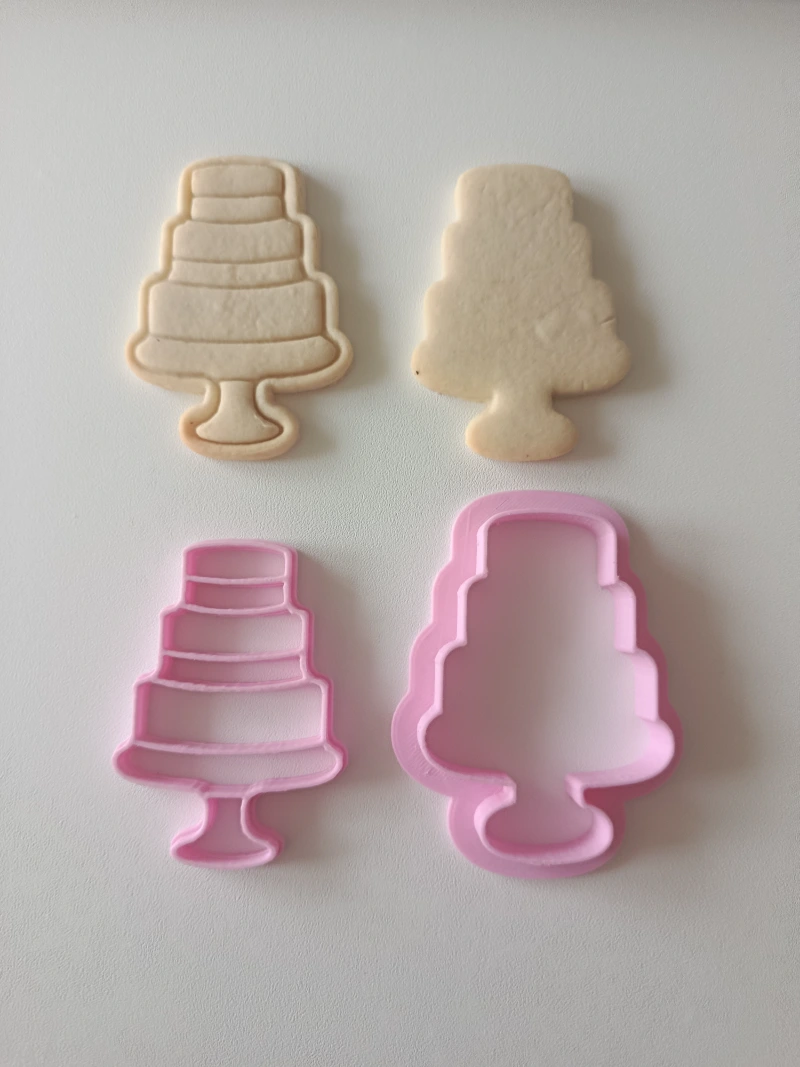
3D printed cookie cutters are designed to shape dough, but buyers should consider the material and the intended conditions of use before using them.
For an appropriate, documented food-contact application, a cutter can be pressed into dough to create the desired shape. However, the actual suitability depends on the finished product and its supporting safety assessment.
Here are several practical precautions.
Avoid Oven Use
A cookie cutter is intended to shape dough before baking, not to be placed in the oven with the cookies.
PLA can soften or deform at elevated temperatures. Therefore, keep PLA cookie cutters away from hot baking trays, ovens, and other high-temperature surfaces.
Remove the cutter before baking.
Avoid Excessive Force
Although 3D printing makes complex shapes possible, thin sections and intricate details may be more fragile than those of some conventional cutters.
Apply even pressure when cutting dough, and avoid twisting or bending delicate sections excessively.
For designs with narrow projections or intricate details, the manufacturer should consider whether the geometry is suitable for the intended application.
Follow Appropriate Cleaning Instructions
Cleaning is an important part of using any reusable food-contact tool.
For PLA 3D printed cookie cutters, a practical starting point is to:
Wash the cutter by hand using warm water and mild dishwashing detergent.
Use a soft brush to remove dough from grooves and detailed areas.
Rinse thoroughly to remove detergent residue.
Allow the cutter to dry completely before storage.
Inspect it for cracks, rough edges, deformation, or trapped residue before reuse.
Avoid assuming that a cutter can withstand every cleaning or sanitizing method. Follow the manufacturer’s instructions and any applicable validated cleaning procedure.
Dishwasher use is generally not recommended for PLA cookie cutters because elevated temperatures and repeated washing may cause deformation or damage.
If a cutter cannot be cleaned thoroughly or has developed cracks, damaged edges, or persistent residue, discontinue its use.
5. Why Do Layer Lines Matter for Food Safety?
One common concern about FDM 3D printing is the presence of layer lines.
These lines are a normal feature of the printing process. Depending on the design and print quality, surface grooves may make it more difficult to remove dough residue completely.
However, it is also important not to assume that every 3D printed surface is automatically unsafe or that bacteria necessarily accumulate in every layer line.
The practical issue is whether the finished product can be cleaned adequately and whether its material and intended use are supported by appropriate evidence.
For manufacturers, this makes design and production control important.
At Canzo Kitchenware, our in-house printing process and standard-speed settings help us focus on consistent product quality. We also recommend that buyers consider the complexity of a design when evaluating its suitability for repeated use.
For example, a simple outline may be easier to clean than a design with numerous narrow recesses and intricate internal details.
When developing a custom cookie cutter, the best approach is to balance visual detail with practical usability.
6. What EU Food-Safety Documents Should Buyers Request?
For importers, wholesalers, and private-label brands selling 3D printed cookie cutters in Europe, documentation is an important part of supplier evaluation.
The applicable requirements depend on the product, material, intended use, and relevant legislation.
Two commonly discussed EU food-contact frameworks are:
Regulation (EC) No 1935/2004: The general framework for materials and articles intended to come into contact with food.
Commission Regulation (EC) No 2023/2006: Requirements concerning good manufacturing practice for materials and articles intended to come into contact with food.
Depending on the material and product, additional specific measures may need to be considered. Regulation (EU) No 10/2011, for example, addresses plastic materials and articles intended to come into contact with food within its scope. Its applicability and requirements should be assessed for the specific product rather than assumed from the fact that it is made from PLA.
A test report, by itself, does not automatically establish compliance with every applicable requirement. Buyers should review the report’s scope, tested samples, methods, results, and relevant conditions of use.
Canzo Kitchenware’s Food-Contact Documentation
For our custom 3D printed cookie cutters, Canzo Kitchenware can provide available EU food-contact test reports and a manufacturer-issued Declaration of Compliance (DoC) for customer review.
These documents can help buyers assess the product for their intended market and application.
Before finalizing an order, we recommend confirming:
Whether the test report covers the relevant material and product.
Which regulations and test methods are addressed.
Whether the intended food-contact conditions are covered.
Whether any limitations or conditions of use apply.
Whether the DoC accurately identifies the product and applicable requirements.
For projects requiring a specific regulatory standard, buyers should communicate their requirements before ordering so that the available documents can be reviewed against those requirements.
Our goal is to give customers clearer product information and practical documentation to support their supplier qualification and compliance review.
7. Are 3D Printed Cookie Cutters Suitable for Commercial Use?
3D printed cookie cutters can be useful for commercial projects, especially when customization and low-volume production are more important than mass-production efficiency.
They are particularly suitable for businesses that need distinctive designs without investing in a dedicated injection mold.
Potential applications include:
Bakery promotions and branded baking accessories.
Custom cookie cutters for gift shops and tourist attractions.
Holiday-themed products for Christmas, Halloween, and other occasions.
Personalized cutters for events, celebrations, and corporate gifts.
Small-batch private-label baking products.
However, suitability for commercial use should not be confused with universal suitability for every food-processing environment.
For high-volume production, intensive repeated cleaning, or applications involving special hygiene requirements, buyers should evaluate whether 3D printed PLA is the right material and manufacturing method.
Stainless steel or other appropriately documented alternatives may be preferable for some demanding applications.
For a custom project, the best choice depends on order quantity, design complexity, intended use, required durability, compliance needs, and target cost.
3D Printing vs. Injection Molding vs. Stainless Steel
| Feature | 3D Printed PLA | Injection-Molded Plastic | Stainless Steel |
|---|---|---|---|
| Initial tooling | Generally no dedicated mold required | Mold development usually required | Tooling depends on the design and forming method |
| Custom shapes | Excellent for intricate, low-volume designs | Suitable for repeat production after tooling | Suitable for many simple and moderately complex shapes |
| Small orders | Often suitable | May be less economical | Depends on design and production setup |
| Design changes | Relatively easy | May require mold modifications | Depends on the manufacturing method |
| Durability | Sensitive to heat and design details | Depends on plastic formulation and construction | Generally durable when appropriately designed and manufactured |
| Food-contact suitability | Requires appropriate material and finished-product assessment | Requires appropriate material and finished-product assessment | Requires appropriate material and finished-product assessment |
There is no single best manufacturing method for every project. For low-volume customized designs, 3D printing offers flexibility. For larger repeat orders, injection molding or stainless steel may provide better long-term economics or performance.
8. Why Choose Canzo Kitchenware for Custom 3D Printed Cookie Cutters?
Canzo Kitchenware supports customized kitchenware projects for B2B customers, including wholesalers, importers, gift suppliers, and private-label brands.
Our 3D printed cookie cutter service is designed for projects that require custom shapes without the initial investment associated with conventional injection molding.
Our Key Advantages
1. Official Bambu Lab PLA filament
We use official Bambu Lab PLA filament for our 3D printed cookie cutters, supporting material identification and production consistency.
2. In-house production
All our 3D printed products are printed on our own machines. This gives us direct control over production and helps us coordinate design adjustments and repeat orders.
3. Standard printing speeds
We use standard printing speeds rather than Sport or Ludicrous modes, prioritizing consistent print quality instead of simply maximizing speed.
4. EU food-contact documentation
We can provide available EU food-contact test reports and a manufacturer-issued DoC for customer review. The suitability of these documents should be confirmed against the actual product specifications and intended application.
5. Flexible custom designs
From simple outlines to detailed promotional shapes, 3D printing allows us to develop customized cookie cutters without requiring a dedicated injection mold for every design.
6. Support for B2B projects
We work with customers on product specifications, design confirmation, material information, and packaging requirements to help develop products for their target markets.
If you are developing a custom cookie cutter for your brand, we recommend sharing your design, estimated quantity, target market, and any specific food-contact documentation requirements before production.
Frequently Asked Questions
Are 3D printed cookie cutters food safe?
They may be suitable for specific food-contact applications when the material, finished product, manufacturing process, and intended conditions of use have been appropriately assessed. PLA alone does not guarantee that a finished cookie cutter is food safe. Buyers should review the relevant product documentation and follow the manufacturer’s instructions.
Is PLA food safe for cookie cutters?
Not all PLA filaments are necessarily suitable for food contact. Different formulations may contain different additives or pigments. The suitability of a finished PLA cookie cutter should be supported by appropriate evidence for the specific material and intended application.
Are Canzo Kitchenware’s 3D printed cookie cutters made from PLA?
Yes. We use official Bambu Lab PLA filament for our 3D printed cookie cutters. All our 3D printed products are manufactured on our own printers using standard printing speeds rather than Sport or Ludicrous modes.
Can Canzo Kitchenware provide EU food-contact test reports?
Yes. We can provide available EU food-contact test reports and a manufacturer-issued Declaration of Compliance (DoC) for customer review. Buyers should confirm the applicable regulations, test scope, and conditions of use for their specific project.
Can PLA cookie cutters go in the dishwasher?
We generally recommend hand washing PLA cookie cutters. Dishwasher temperatures and repeated exposure to heat may cause deformation or damage. Use warm water, mild detergent, and a soft brush, then dry the cutter completely before storage.
Can you use a PLA cookie cutter in the oven?
No. A PLA cookie cutter is intended to cut dough before baking, not to be placed in the oven. PLA can soften or deform at elevated temperatures, so remove the cutter before baking.
Are 3D printed cookie cutters better than stainless steel cutters?
Neither option is universally better. 3D printed PLA cutters are useful for customized designs and smaller production runs. Stainless steel cutters are generally more durable and may be preferable for intensive or repeated use. The right option depends on the intended application, design, order quantity, and relevant food-contact requirements.
Can I order custom 3D printed cookie cutters without an injection mold?
Yes. One of the main advantages of 3D printing is that customized designs can generally be produced without developing a dedicated injection mold. This makes the method useful for small batches, intricate shapes, and projects that require design flexibility.
Conclusion
So, are 3D printed cookie cutters food safe?
The answer depends on more than the choice of PLA. Material composition, manufacturing control, the finished surface, cleaning practices, intended conditions of use, and relevant compliance documentation all matter.
For businesses sourcing custom cookie cutters, choosing a manufacturer that can identify its materials, control its production process, and provide relevant supporting documents is an important step.
At Canzo Kitchenware, we use official Bambu Lab PLA filament, manufacture all our 3D printed cookie cutters in-house, and use standard printing speeds to support consistent product quality. We can also provide available EU food-contact test reports and a manufacturer-issued DoC for customer review.
If you are looking for a manufacturer for custom 3D printed cookie cutters, contact Canzo Kitchenware with your design, estimated order quantity, target market, and documentation requirements. Our team can help you evaluate the appropriate manufacturing approach for your project.